Psychotherapist Dr. Russ Harris was looking forward to welcoming his first child. But it wasn’t long after his son was born that he realized something wasn’t quite right. As the baby grew, he didn’t walk but scooted on his tush. He was barely verbal. By the time his son was two years old, Harris had a diagnosis: autism.
Harris descended into a deep depression – surprising, perhaps, given that Harris is a world leader in explaining ACT (Acceptance and Commitment Therapy) to the layperson. ACT weaves the practice of mindfulness into cognitive behavior therapy (CBT). I devoured his first book, “The Happiness Trap,” which has helped me on numerous occasions.
But Harris is also human, and his initial reaction was entirely understandable.
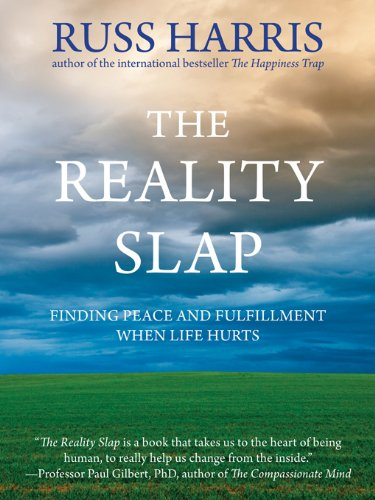
Harris wrote another book, this one about on his experience with his son. It’s called “The Reality Slap” and it’s based on a term that powerfully identifies what so shook Harris: The reality he expected for his life did not match the actual reality he now faced.
“The reality slap takes many different forms,” he writes. “Sometimes it’s so violent, it’s more like a punch: the death of a loved one, a serious illness or injury, a freak accident, a violent crime, a disabled child, bankruptcy, betrayal, fire, flood or disaster. At other times, the slap is somewhat gentler: that sudden flash of envy when we realize someone else has got what we want; those sharp pangs of loneliness when we realize how disconnected we are from others; that burst of anger or resentment over some sort of mistreatment.”
The concept of the reality slap spoke to me as soon as I read the line, “a serious illness.” It has since helped provide context as to why the last year has been so tough.
My “expected reality” was that I would be healthy well into my golden years; that my wife, Jody, and I would, as empty nesters, travel the world; that we would hike the Salkantay Trail to Machu Picchu; that we would be able to hoist our grandchildren into the air, if not effortlessly than effervescently.
Instead, I’ve spent the last 12 months first in declining then slowly improving health, ever since my cancer surged and eventually sent me to the hospital for six weeks until the miraculous CAR-T treatment knocked the cancer out.
Now that I’m feeling stronger – as I like to phrase it “trying to live a normal life in an abnormal body” – and I look back at the previous year, I realize that my own reality slap was made more personally painful by my inability – or perhaps my unwillingness – to accept that it had occurred in the first place.
That makes sense: For seven years, I was reassured I had an “easy cancer.” It was slow growing and, while I’d need treatment every once in a while, I “wouldn’t die from it but with it.” That all changed when it transformed from indolent Follicular Lymphoma to aggressive DLBCL.
I could no longer “watch and wait,” as I had been doing for most of those years. If it wasn’t treated quickly, I would most certainly die.
Reading Harris’s book, it’s clear that while “sometimes the slap quickly recedes into memory – a passing moment, a brief ‘rude awakening’ – at other times it knocks us senseless and leaves us wandering in a daze.” And the slap is just the beginning. “For once the slap wakes us up, we then face the gap.” And it can persist for a lifetime.
Indeed, one of the learnings I’m trying to integrate is not to expect that I’ll ever get back to 100% but to be OK with just 70%, while at the same time living with the uncertainty that, any given morning, I could wake up feeling 50%…or 80% of my old self.
“What do we do when we can’t close that reality gap?” Harris asks. Or when we can close it, “but it’s going to take a long, long time to do it. How do we cope in the meantime?”
For Harris, the answer is all about how to put the principles of ACT into practice. Using the framing device of a reality slap, he presents a variety of principles.
- “Defuse” from thoughts like, “It will never get better” or “My life is ruined.” Shift from “I’ll never cope with this” to “I’m having the thought that I’ll never cope” (a classic meditation and ACT technique).
- Focus on values: Given this life, this body and this situation, how do I want to live? Small actions, like a five-minute phone call, a short walk or a grandchild’s smile (even when you can’t roughhouse) can help. If you can’t get back to 100%, those values become the most important.
- Expect setbacks and “re-slaps.” The reality gap will never fully close. You’ll have days when it feels hopeless. Relapse is the rule. Can you still build something meaningful within the changed landscape?
- Someone exhorting you to “just be grateful” is never helpful. You need to grieve, then ask: What kind of person do I want to be in this reality?
- Your reactions are normal human responses to loss and threat. They’re not signs of failure.
- Acceptance is about making space for unpleasant experiences so you can move your life in directions that matter. It doesn’t mean saying, “I’m fine with the reality that I’m sick or weak.” Instead, tell yourself, “These limitations are here whether I like them or not. So, how can I treat my body, my partner and my friends in ways I won’t regret?”
“The Reality Slap” has given me new tools to cope with my own gap. I hope those tools will be helpful for you, too. I didn’t expect the last year – heck, I didn’t expect the seven years before that, either – but I survived. Harris’s framing of the slap has helped me to better understand what to do if I’m faced with another life-changing reality gap.
I first wrote about my reality slap for The Jerusalem Post.