Everyone else saw it. My wife, Jody, saw it. My kids all saw it. The few friends who were able to visit me in the hospital saw it. Even my doctors saw it.
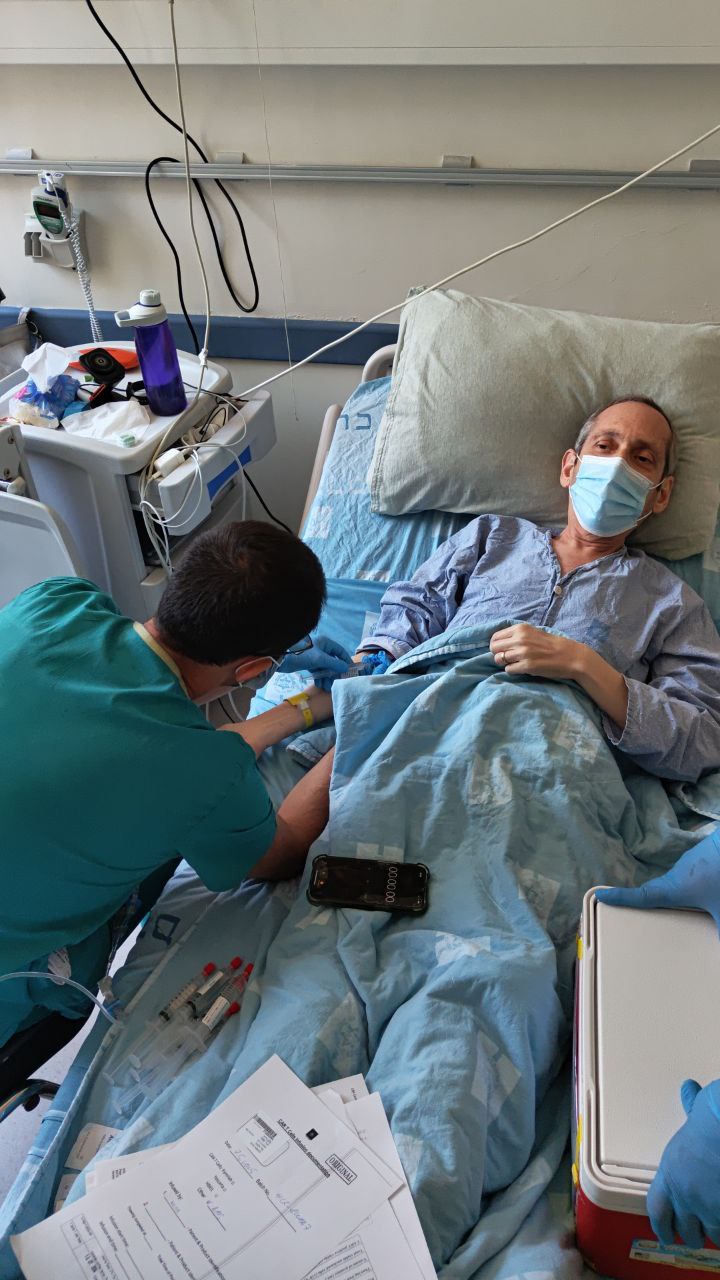
Everyone but me could see that I was dying.
“I don’t think he’s going to make it long enough to start the CAR-T,” Jody wrote to my hematologist in a moment of extreme non-equanimity.
CAR-T was my last-chance treatment for knocking out the lymphoma I’d hosted, mostly benignly, for the previous seven years, until it unexpectedly and quite dramatically transformed into one of the most aggressive and fast-growing variants of the disease.
“Is there any way to speed up the process of getting the CAR-T injected?” Jody implored.
There wasn’t. Protocols had to be followed, which meant completing a battery of tests and procedures smartly meant to keep me safe. You wouldn’t want to skip the three days of the lympho-depleting chemo that is administered prior to the CAR-T itself, for example, only to discover that the decision led to being fatally under or overdosed.
What I didn’t see, that everyone else around me did, was my rapidly deteriorating body. Maybe it was the lack of a full-length mirror in the hospital isolation room. Maybe it was the crappy lighting.
Maybe I just didn’t want to look.
And so, I didn’t see how my muscles were being steadily eviscerated; how those saggy middle-aged male breasts I had oft wished gone had now done exactly that, leaving an unfamiliar hollowness in my chest; how my legs and arms were pencil-stick memories of their former runner’s robustness.
With no disrespect to those who have undergone far worse, my body now shockingly resembled that of a Holocaust survivor.
The reason for this ability to finally see clearly was my release from the hospital at the end of May after nearly six weeks in an isolation room on the Bone Marrow Transplant ward.
In truth, I didn’t feel ready. I was so weak. I was fearful of being far from the nurses who had taken such good care of me, the food (as bland and repetitive as it was) that arrived punctually three times a day, the red button by the side of the bed I could press at any time if I needed something (more meds, a shoulder to cry on, opioids), even the cumbersome chair and handrails in the shower and bathroom.
“You’ll recover better at home, away from here,” Dr. Eran tried to reassure me. Dr. Batya and Dr. Elias concurred.
When I finally examined myself in the wall-length mirror in our bedroom at home and I saw, with a bolt of terrifying clarity, the extent of the devastation the cancer had wrought on my body, tears began to flow – both for Jody and me – as we realized how close we’d come to the end (not that we’re entirely out of the woods yet).
In a way, the six weeks I was hospitalized represented for me a kind of “coma of denial,” in that I had been denying the gravity of my story without even knowing that my story was as grave as it was.
Which raised a question: Did Jody – and everyone else who’d seen me so intimately – do the right thing by “hiding” the truth, whether intentionally or not, about my situation?
In other words, if Jody had told me, prior to starting CAR-T, she thought I wouldn’t get there, would that have incentivized me to push harder and disprove her fears – or would it have made me more likely to give up?
There are pros and cons to both approaches.
The benefits of knowing include:
- Empowerment and autonomy, which allow you to make informed choices about your treatment, care and time. You gain agency and can better embrace the moment.
- Emotional preparation – if your options look poor, you can use your time to get ready, write letters to loved ones and put your affairs in order by stripping away distractions.
- Improved adherence to treatment – knowledge of how bad your situation is can help you follow more scrupulously the doctor’s orders.
There are two main downsides:
- Psychological burden – knowing too much can trigger despair or depression which can negatively impact your approach to recovery and what quality of life you have left.
- The “nocebo” effect – rather than improving outcomes as in its better-known cousin, the so-called “nocebo” (or “anti-placebo”) effect can result in negative expectations which, whether borne out to be true or not, can worsen how you fare.
One caveat – and it’s a biggie: If your situation is potentially recoverable, knowledge can create a better balance between hope and realism. On the other hand, if the illness is terminal, knowing what’s coming may be the best way to grapple with letting go on a tight timeline.
I know, for me, that Jody made the right choice. Despite the positivity which I try to exude in these essays, if it’s just you and me chatting openly, I will quickly devolve into binary thinking that isn’t not particularly helpful.
Indeed, I fear had I been told I was dying, I might very well have.
Mindfulness, grief and bereavement counselor Stephen Levine writes in his book One Year to Live that contemplating mortality openly can help remove the fear surrounding death, a practice he calls liberating, not morbid.
I asked a friend how she’d react to my philosophical question. Her response dovetailed Levine’s.
She’d want to know, she said, so she could get a head start on developing a “relationship with death.” Even if she recovered, she’d now have new understandings to build on when the time came – as it will, of course, for all of us.
I imagine she wouldn’t have fallen into a coma of her own denial.
I first wrote about how I almost died for The Jerusalem Post.